Thursday, 24 December 2015

Hunger

"There are no miracles or mysteries in cycling. It's just a question of how much you can suffer."

So wrote Irish cyclist Sean Kelly in his highly recommended autobiography Hunger. I am starting to come to a similar view on the subject of writing SciFi novels. You can sit around, looking at a blank screen and a flashing cursor, waiting to be touched by the ethereal finger of Arthur Charles Clarke to gain inspiration or you can get on with it and write something. Every day.

I finished my second novel, Redeeming Blood, this week and from the first word to the last it took me just over eight months. As my first book took me over five years this is a very welcome improvement in productivity. What was the difference in the two experiences? Well, by the time I started the second book I had detected a modicum of appetite for my first book in the industry. So I started to believe that this is something I could really do and I wanted to do more of it. In short, I got hungry and worked relentlessly hard at the second book.

In my not entirely unbiased opinion I believe the second book is a stronger piece of work in some ways than the first. It has more coherence and better structure from not having such a protracted gestation.

In other news, my third book will be called Weft and will not be related to WaCW or RB but will take place in the same imagined future. I have a storyboard and some notes for it but I am going to take a break after the death march of simultaneously rewriting WaCW and finishing RB. So the first word of Weft will not be written until 1st July 2016 and will not be complete until spring 2017.

Tuesday, 15 December 2015

Sci Fi on TV

While doing nothing in particular on the Internet I noticed that Corey's The Expanse is being adapted for television. This is obviously another sign of the television industry's never ending quest to find the Sci Fi equivalent of GoT. See also RGB Mars on Spike.

What strikes me about the still shots from The Expanse is that it seems to be lots of good looking young people with great hair in a lowest-common-denominator vision of what things will look like 200 hundred years hence.

It looks like every post Battlestar Galactica reboot Sci Fi show that's filmed on the cheap in Canada. We need a SciFi show with a genuinely different and new visual language that demonstrates the otherness of the future.

Thursday, 3 December 2015

Redeeming Blood

I have had some correspondence about the Without a City Wall sequel. Specifically, I've had enquiries about what characters are coming back and when it will be finished.

The book is called Redeeming Blood and the first draft will be going to proof-reading  and to my normal test pilots in January 2016.

Here's what I am prepared to reveal in a completely spoiler-free zone:

  • It's another dual narrative novel like WaCW and is about the same length.
  • There is no departure in style. Like WaCW, RB is dark, complex and funny.
  • The Orthus story arc takes place just after the events at the end of WaCW.
  • The other story arc is situated in Africa, the Middle East and on Mars.
  • Two of your favourite characters are coming back.
  • Two of your other favourites aren't.
  • The protagonist is a middle aged alcoholic from Newcastle.
  • We see a lot more of Manhattan and the rest of the planet of Orthus.
  • In the same way that WaCW is a book about women, RB is a book about men.

Tuesday, 1 December 2015

On Being Edited

For years, five at least, I wandered alone through my book, Without a City Wall. There was just me and the characters developing our own comfortable little co-dependency. During this period of solitude, which was 95 years fewer than the period prescribed by Gabriel Garcia Márquez, I managed to convince myself that the book was good.

When I finished the book I began to show it to other people and was gratified to discover that, on the whole, they agreed with me; the book was good. All was well in the unpublished author's reality distortion field.

Then the book was edited by somebody who knew what they were doing.

If pressed to describe my emotional reaction to reading the marked up manuscript I would say this:

Imagine being slapped across the face by somebody you respect approximately 150 times.

Now, here I have to offer some context. The person who edited my book quite obviously knows their shit and presented their comments in a professional and logical manner. Additionally,  all of their ideas and remarks were relevant and of worth. The only possible reasons not to recognise and act upon them would be some misplaced sense of artistic pretension or laziness.

That just made it worse.

The insights they provided were so transparently valuable that I cursed myself for not seeing what they saw. Once I recovered from my initial feelings I quickly realised that I had to channel that energy. I have been blessed, in the strictly secular humanist sense of the word, to have the chance to make Without a City Wall a far stronger and more compelling book as a result of the editing process.

So, profound thanks to AR. Those slaps across the face will not be in vain.

Friday, 27 November 2015

Business Secrets of the Pharoahs

The first thing to note when discussing the business secrets of the Pharaohs is an acknowledgement that their era was so completely different from our own that almost all cultural, political and, particularly, business parallels we draw between the two eras are bound, by their very nature, to be wrong.

If you want a pitch perfect rendition of the experience of being unpublished author then consider Business Secrets of the Pharoahs. The book, referred to for reasons of brevity as "Secrets" hereafter, was written by the character Mark Corrigan in the British TV series "Peep Show".  The effect of the perenially unpublished book on Mark and his life is very well observed and will strike a chord with all unpublished writers.

  1. It goes on for years. Secrets is first mentioned in season 1 when Super Hans destroys a laptop containing an early draft. Seven years later in season 8 it is still unfinished and unpublished.
  2. In times of personal crisis the book becomes the repository of all Mark's hopes and dreams. When he is made redundant one of his immediate thoughts is that he will now "really nail" Secrets.
  3. Mark desperately wants the validation and concomitant self-respect that would come from being able to describe himself as a published author. This eventually leads him into the toxic fantasy world of vanity publishing.

Try season 8, episode 2 of Peep Show for entire show devoted the eternal struggle of the unpublished author with his own integrity.

Sunday, 15 November 2015

Ni Trompettes, Ni Tambours

In 1970 François Truffaut wrote and directed the film Domicile Conjugal, the fourth in the series concerning the life of the louche young man Antoine Doinel. The work duly observes the conventions of the nouvelle vague genre by featuring a bleak, autumnal view of Paris and many scenes in which the leading man, Jean-Pierre Léaud, smokes langourously with fantastic hair.


In one scene Antoine tells a barman that he is writing a novel. The fact that he is in a bar rather than typing at a desk is telling. The conversation proceeds thusly:

Barman: What's the title?

Antoine: I don't know yet.

Barman: Does it have trumpets?

Antoine: No.

Barman: Does it have drums?

Antoine: No.

Barman: Why not call it "Neither Trumpets Nor Drums" then?

This is a fantastic method of generating titles and I wish I'd known of when I suffered protracted anguish coming up with the title of my novel. Any prospective title has to be memorable, somewhat allusive to the themes of the book, not previously used and, ideally, easy to google.

 I examined and rejected many titles before coming up with "Without a City Wall" which was a phrase from hymn that I remembered singing as a child at school. It meets three of the four desirable characteristics I describe above and was easily the best of the mostly awful options I considered.

Tuesday, 10 November 2015

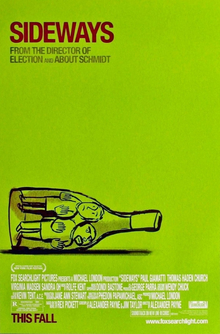
Sideways

I am always drawn to and am interested in depictions of the writing experience in film and other media. Sideways is one of the best. It is a 2004 Alexander Payne film adapted from the novel by Rex Pickett that stars Paul Giamatti and Thomas Hayden Church.


There are no actual scenes of writing in Sideways but, in a sense, that's the point. The experience of writing and trying to get one's work published is transformative many facets of one's life beyond the process of production itself. Sideways captures this with eery fidelity and a deft emotional tone. The character Myles has an unpublished manuscript that is the centrepiece of his life. He has not found fulfillment or success in marriage or career and now has nothing but this book. A book to which the publishing business appears cruelly indifferent. The film show in unsparing cruelty the inflation and then the destruction of Myles' hopes.

Beyond its resonance to the writer Sideways is simply a great film with complex and well drawn characters, a subtle comedic touch and moments of genuine pathos.

"In search of wine. In search of women. In search of themselves."


Sunday, 1 November 2015

Dubai

It is a tragedy that George Alec Effinger did not live long enough to see his vision of the Budayeen made real in the United Arab Emirates.

In the Marîd Audran novels he describes a vast commercially vibrant metropolis in the Middle East around which visitors from the jaded, declining states of the West would stagger in awe.

When Effinger published the first novel in the trilogy, When Gravity Falls, in 1987 such a vision of economic and cultural ascendency of Asia and the Middle East seemed fanciful. From the perspective of 2015 it looks prescient
 

Wednesday, 28 October 2015

Reading Outside the Genre

Garth Marenghi once famously observed that he was the only writer that has written more books than he has read. Obviously now that Russell Brand has written two books the claim is open to challenge but it still raises an interesting question.

To what extent is it desirable to read other works outside one's genre?

Imagine writing an SF novel if all one had ever read was other SF novels. What would the final product be like? My unproven assumption would be that work would be anodyne and unchallenging to the reader. SF is the literature of ideas and those ideas are, on occasion, best mined from outside the genre.

My settled view is that if one is going to learn the craft of writing by reading then learn from the best. If you want the unsurpassed study of psychological disintegration then read Crime and Punishment. If you want to see a perfectly structured novel then reach for The Good Soldier. If you want to experience the benchmark work of magical realism then it's Love in the Time of Cholera you need.


Thursday, 22 October 2015

Writing the Numbers

In writing Sci Fi one thing becomes readily apparent; this shit is full of numbers. There are many references to dates, distances, speeds and other such assorted bollocks. So how does one correctly write numbers in English prose? On whether numbers should be represented by words or digits there is a doctrinal schism.

The much vaunted Chicago Manual of Style recommends using words for numbers one through ninety nine and digits for 100 and above.

By contrast the Associated Press Style Book advocates one through forty as words and digits for 41 and thereafter.

Personally, I favour the AP approach as, for reasons I can't fully articulate, it feels more contemporary.

As we are dealing with English, which is a parasite ridden mongrel cur of a language, there are some exceptions. These include, but are not restricted to:

  • Numbers at the start of a sentence should be expressed in words regardless of their value.
  • Numbers that are not integer values should be expressed in digits.

There also areas of ambiguity which are left to the personal taste of the author to arbitrate. For instance the question of negative numbers remains unresolved. I personally favour expressing them digits. If you know differently, and can cite and authoritative source, please let me know.

Thursday, 15 October 2015

The Process

"Hey, man! What's your process?' Asked nobody, ever.

Well, seeing as you didn't ask I'll tell you anyway. I work on one project at a time and I write 500 words every day. The only recent exemption to this rule was the day I had my wisdom teeth out on my birthday. I felt that act itself was already sufficiently laden with symbolism that writing seemed redundant.

If I had the luxury of being a full time writer then my target would be 2,000 words a day, every day.

The routine of working every single day with no fallow periods is important for two reasons. First, it harnesses the power of habit. After approximately 100 days of this routine the prospect of missing a day and breaking the streak is enough to induce a state of existential terror. Second, if one works at a book every day one is always thinking about it. It's always at the forefront of the mind and everyday things seen or read may provide relevant inspiration.

Haruki Murakami is probably the most famous proponent of this school of producing a book via the long march. He draws upon a inexhaustible well of energy to write for six hours starting at 4am every day and describes the process as 'mesmerisation through repetition' and ominously likes writing  a novel to 'survival training'.

I start my daily writing by a review and edit of the previous day's output. All new material is written in a rather displeasing green colour to make it easy to identify for subsequent revision. I run a specially created Ubuntu linux virtual machine with LibreOffice and Dropbox to handle the content creation and data protection.

So write something every day. Even it's a suppurating canker on the face of English literature it can always be improved. The only piece of writing that can't be improved is the blank page or screen of the writer who chose to write nothing.


Thursday, 8 October 2015

Write the Book You Want to Read

If I were in the business of dispensing advice to prospective authors this is probably the most valuable thing I could share with them. Why do I say this? After all, the authors tastes may or may not intersect with what is commercially successful and therefore intensely craved by publishers and agents. A quick perusal of the SF&F shelves at the airport would lead an author to believe that what they should be writing is a Young Adult series about a teenage vampire who is attending a high school where she learns how to be a good vampire and not abuse her powers for evil. This work could, perhaps, be distinguished from the plethora of similar crap by having the title in a sans serif font.

The reason I would never counsel anyone just to write what is currently selling is that writing a book is incredibly hard work. If the author doesn't love the characters, story and themes then the process is going to seem even more onerous that it already is. If the book you are writing isn't a book that you desperately want to experience then the inspiration and enthusiasm aren't going to be sustainable. If you don't write the book you want to read then, in my opinion, you won't end up writing any book at all.

Footnote: If any publisher would like to pay me mad cash to write the Elyssa Bloodmoon: Vampire Academy series the answer is, of course, yes.

Wednesday, 30 September 2015

The Difficult Second Album

It's a music business truism that's as old as Cliff Richard's wig; the second album is difficult and a potential career wrecker. There are, of course, exceptions such as a It Takes a Nation of Millions to Hold Us Back that completely eclipse the artist's first album but it's a truism for a reason.

As I enter the final stages of my second Sci Fi novel, Redeeming Blood, I am beginning to have some empathy for my coke addled counterparts in the music business. The second book set in the same universe is, of course, a different propostion to a second album but there is the same inescapable conclusion: it's difficult. However, it's difficult in different ways. I have no brand or public perception that defines me or my output and into which my second book has to fit but I do have other challenges.

Some of the difficulties stem from the constraints of a shared universe. When I started Without a City Wall the entire universe was mine. It was a tabula rasa upon which I could create whatever pleased me. Now that I am adding more stories that are close to or even coincident with the events of the first book I have to make events logically and chronologically consistent. This demands a more organised style of writing and more planning than was necessary for my first effort.

Another hazard is deciding on the degree of autonomy for the second book. This in an issue that I have revisited multiple times in Redeeming Blood and I've changed my mind every time. This book is clearly a companion piece to the first but to what extent should it stand alone? For it to work as a completely independent piece of fiction it would require an enormous amount of exposition of the events of Without a City Wall. So there is a careful balance to be struck on this matter and that takes a lot of thinking and a lot of rewriting. Dune Messiah is a fantastic book but can its artistic value be fully realised if one has never read Dune? I would conclude that answer is no and I will, therefore, add no more information in Redeeming Blood than is necessary to sustain that book's narrative arcs.

There is a positive aspect to the second novel experience and that is confidence. It took me a very long time to write Without a City Wall and during that protracted gestation I experienced many periods of Alvy Singer style self-doubt. With Redeeming Blood I am reinforced with the knowledge that I can finish a Sci Fi novel and it can be good.


Thursday, 24 September 2015

The Agent

Before I started on the journey of being a published author my only frame of reference on the business of publishing came from tangential references in Alan Bennett's diaries. I therefore knew what to say at a dinner party with Harold Pinter but had absolutely no idea how one got a book published.

To pursue what is known as a 'trade publishing' arrangement an agent is necessary. This is a person who can evaluate a book, judge its commercial worth, and introduce it to publishers. It may, in theory, be possible to secure a publishing deal without an agent and it may even, in practice, actually happen but it is an event of such rareness as to not merit discussion here.

An author finds an agent for their work by the process known as 'querying'. In the query the author will describe their book in brief (but not too brief) and positive (but not too positive) terms in order to convince the agent of its merit. Some agents will require a sample of the work, others may ask for it later should their interest be sufficiently piqued.

At times during my efforts to secure the services of an agent for my work I felt akin to Sir Pellinore in Le Morte d'Arthur; doomed to spend a lifetime in pursuit of the Beast Glatisant but never actually to catch it. However, I did succeed and I have a terrific agent.

This is what I've learned:


  • It's a long process, my average response time from prospective agents was 71 days from the initial contact.
  • The effort must be targeted. Concentrate on agents who are open to submissions in your genre. If you carpet bomb the entire literary agents' community regardless of their suitability to you and your work then you're just wasting TCP/IP packets.
  • Follow the instructions on submissions precisely. Their game, their rules.
  • Build an interaction. Write something engaging and personal in your query that shows you've put some effort into understanding the agent's needs. Simply doing Ctrl-V every time with your query isn't going to get it done.
  • Finally, make sure you've written a really good book and get comfortable describing it and discussing it!


My numbers:

Agents queried: 39

Responses: 16 (41%)

Rejections: 14 (88% of responses received)

Offers of representation: 2


Wednesday, 23 September 2015

The Rutter Continuum - First Sequence

This was a blog post I wrote in Doha in the summer of 1999. It bore the grandiloquent title of "On the Trail of the Desert Bigfoot" and was accompanied by pictures of me in gorilla suit in the dunes of the Umm Said area of Qatar. Sadly, none of the pictures survive. I can only assume that my foremost literary influences at that time were H.P. Lovecraft and Viz.

Our story starts in mankind's oldest inhabited city, Damascus. I was in the old town, in a tea shop just to the east of the Great Omayyed mosque. It was dusk on a hot and humid July evening, the sonorous call to prayer drifted over the city's dusty, cluttered rooftops. I sipped at a small glass of hot bitter tea and looked across the table into the dark eyes of the man seated there. He had a leathery weather-beaten face with a covering of white stubble. It was a face that hinted at an untold story of unspeakable hardships endured in the desert. I deliberately broke his gaze and looked up at the towering minarets.
"So. You have the map?" I inquired softly.
Without a word he slid an ancient piece of parchment across the table toward me. His hand remained firmly on top of it.
"Inglezi. You know the nature of that which you seek? Only madness and death can result from this enterprise!" He croaked. His was a harsh guttural voice, yet he spoke refined Arabic with a Cairo accent. Silently I pushed an envelope across the table. It contained 5,000 US dollars. He stared at the envelope for thirty seconds before raising a trembling hand from the map and claiming it. Immediately standing up he looked at me as I picked up the map.
"Do not search for Al-Malyaam, Inglezi. Only evil can come of it." With that he disappeared into the heaving crowds around the mosque.
The Al-Malyaam or Desert Bigfoot is a large primate rumored to inhabit a remote region of the Rub-Al-Khali desert in the Empty Quarter of the Arabian Peninsula. No specimens have ever been found and only a few eye witness accounts exist. And after five years of laborious research in libraries and universities from Prague to Melbourne I held in my hand a map that could lead to a sighting of the Desert Bigfoot. As I travelled deeper into the desert following the ancient writings on the map my mind turned increasingly to thoughts of the curse the old man had mentioned. Yet the staff at The Rutter Continuum place little value on their sanity or personal safety when weighed in the balance against our readers' unquenchable thirst for enlightenment. On the twelfth day of my journey I spied a nugget. Not of gold, though my joy could not have been greater had it been the most precious of precious metals. No, it was a glistening brown nugget of shit. It was a fresh Desert Bigfoot dropping laden with worms and other varieties of parasites! I immediately scooped it up and inhaled deeply. Yes! There was the distinctive nauseating aroma which legend tells us is typical of Bigfoot shit.
My heart started to race I knew now that I must be close. Then, I heard the low howling wail from far across the dunes. I started to sprint across the sands desperate that my quarry should not elude me now that I was so close. As I reached the top of a large dune I looked down into a valley. There, I saw it. The Desert Bigfoot.
I sank to my knees as of tears of joy coursed down my cheeks. It was a strange and beautiful sight with its coarse black fur caked with excrement and other filth. It disappeared over the crest of the dune with a curious rolling gait. One fleeting glimpse was not enough I staggered to my feet and started to pursue this marvelous beast. I tracked it for hours across the burning sands. It was a magnificent spectacle to see this huge primate striding across the desert continually groping its genitals as it walked.
The beast knew not that I followed it for the senses of the Desert Bigfoot are reputedly very dull. But my fascination for this animal overpowered my sense of caution and I strayed too close. The shy and gentle creature began to pursue me across the dunes, screaming and gesturing wildly.
After a chase lasting many hours, the burning eye of the sun began to drop behind the shifting mountains of sand. The Desert Bigfoot grew tired of the pursuit and returned to it's filth-hole somewhere in the vast sandy desert where doubtless a litter of hungry young Bigfoot cubs waited for the return of their parent who would probably eat them.