Friday, 27 November 2015

Business Secrets of the Pharoahs

The first thing to note when discussing the business secrets of the Pharaohs is an acknowledgement that their era was so completely different from our own that almost all cultural, political and, particularly, business parallels we draw between the two eras are bound, by their very nature, to be wrong.

If you want a pitch perfect rendition of the experience of being unpublished author then consider Business Secrets of the Pharoahs. The book, referred to for reasons of brevity as "Secrets" hereafter, was written by the character Mark Corrigan in the British TV series "Peep Show".  The effect of the perenially unpublished book on Mark and his life is very well observed and will strike a chord with all unpublished writers.

  1. It goes on for years. Secrets is first mentioned in season 1 when Super Hans destroys a laptop containing an early draft. Seven years later in season 8 it is still unfinished and unpublished.
  2. In times of personal crisis the book becomes the repository of all Mark's hopes and dreams. When he is made redundant one of his immediate thoughts is that he will now "really nail" Secrets.
  3. Mark desperately wants the validation and concomitant self-respect that would come from being able to describe himself as a published author. This eventually leads him into the toxic fantasy world of vanity publishing.

Try season 8, episode 2 of Peep Show for entire show devoted the eternal struggle of the unpublished author with his own integrity.

Sunday, 15 November 2015

Ni Trompettes, Ni Tambours

In 1970 François Truffaut wrote and directed the film Domicile Conjugal, the fourth in the series concerning the life of the louche young man Antoine Doinel. The work duly observes the conventions of the nouvelle vague genre by featuring a bleak, autumnal view of Paris and many scenes in which the leading man, Jean-Pierre Léaud, smokes langourously with fantastic hair.


In one scene Antoine tells a barman that he is writing a novel. The fact that he is in a bar rather than typing at a desk is telling. The conversation proceeds thusly:

Barman: What's the title?

Antoine: I don't know yet.

Barman: Does it have trumpets?

Antoine: No.

Barman: Does it have drums?

Antoine: No.

Barman: Why not call it "Neither Trumpets Nor Drums" then?

This is a fantastic method of generating titles and I wish I'd known of when I suffered protracted anguish coming up with the title of my novel. Any prospective title has to be memorable, somewhat allusive to the themes of the book, not previously used and, ideally, easy to google.

 I examined and rejected many titles before coming up with "Without a City Wall" which was a phrase from hymn that I remembered singing as a child at school. It meets three of the four desirable characteristics I describe above and was easily the best of the mostly awful options I considered.

Tuesday, 10 November 2015

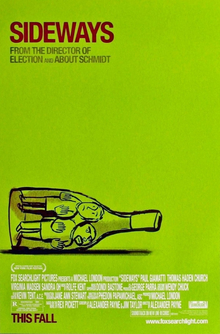
Sideways

I am always drawn to and am interested in depictions of the writing experience in film and other media. Sideways is one of the best. It is a 2004 Alexander Payne film adapted from the novel by Rex Pickett that stars Paul Giamatti and Thomas Hayden Church.


There are no actual scenes of writing in Sideways but, in a sense, that's the point. The experience of writing and trying to get one's work published is transformative many facets of one's life beyond the process of production itself. Sideways captures this with eery fidelity and a deft emotional tone. The character Myles has an unpublished manuscript that is the centrepiece of his life. He has not found fulfillment or success in marriage or career and now has nothing but this book. A book to which the publishing business appears cruelly indifferent. The film show in unsparing cruelty the inflation and then the destruction of Myles' hopes.

Beyond its resonance to the writer Sideways is simply a great film with complex and well drawn characters, a subtle comedic touch and moments of genuine pathos.

"In search of wine. In search of women. In search of themselves."


Sunday, 1 November 2015

Dubai

It is a tragedy that George Alec Effinger did not live long enough to see his vision of the Budayeen made real in the United Arab Emirates.

In the Marîd Audran novels he describes a vast commercially vibrant metropolis in the Middle East around which visitors from the jaded, declining states of the West would stagger in awe.

When Effinger published the first novel in the trilogy, When Gravity Falls, in 1987 such a vision of economic and cultural ascendency of Asia and the Middle East seemed fanciful. From the perspective of 2015 it looks prescient