Sunday, 15 November 2015

Ni Trompettes, Ni Tambours

In 1970 François Truffaut wrote and directed the film Domicile Conjugal, the fourth in the series concerning the life of the louche young man Antoine Doinel. The work duly observes the conventions of the nouvelle vague genre by featuring a bleak, autumnal view of Paris and many scenes in which the leading man, Jean-Pierre Léaud, smokes langourously with fantastic hair.


In one scene Antoine tells a barman that he is writing a novel. The fact that he is in a bar rather than typing at a desk is telling. The conversation proceeds thusly:

Barman: What's the title?

Antoine: I don't know yet.

Barman: Does it have trumpets?

Antoine: No.

Barman: Does it have drums?

Antoine: No.

Barman: Why not call it "Neither Trumpets Nor Drums" then?

This is a fantastic method of generating titles and I wish I'd known of when I suffered protracted anguish coming up with the title of my novel. Any prospective title has to be memorable, somewhat allusive to the themes of the book, not previously used and, ideally, easy to google.

 I examined and rejected many titles before coming up with "Without a City Wall" which was a phrase from hymn that I remembered singing as a child at school. It meets three of the four desirable characteristics I describe above and was easily the best of the mostly awful options I considered.

Tuesday, 10 November 2015

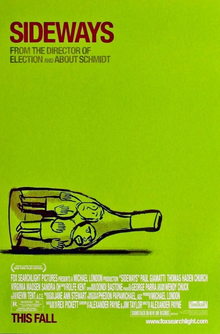
Sideways

I am always drawn to and am interested in depictions of the writing experience in film and other media. Sideways is one of the best. It is a 2004 Alexander Payne film adapted from the novel by Rex Pickett that stars Paul Giamatti and Thomas Hayden Church.


There are no actual scenes of writing in Sideways but, in a sense, that's the point. The experience of writing and trying to get one's work published is transformative many facets of one's life beyond the process of production itself. Sideways captures this with eery fidelity and a deft emotional tone. The character Myles has an unpublished manuscript that is the centrepiece of his life. He has not found fulfillment or success in marriage or career and now has nothing but this book. A book to which the publishing business appears cruelly indifferent. The film show in unsparing cruelty the inflation and then the destruction of Myles' hopes.

Beyond its resonance to the writer Sideways is simply a great film with complex and well drawn characters, a subtle comedic touch and moments of genuine pathos.

"In search of wine. In search of women. In search of themselves."


Sunday, 1 November 2015

Dubai

It is a tragedy that George Alec Effinger did not live long enough to see his vision of the Budayeen made real in the United Arab Emirates.

In the Marîd Audran novels he describes a vast commercially vibrant metropolis in the Middle East around which visitors from the jaded, declining states of the West would stagger in awe.

When Effinger published the first novel in the trilogy, When Gravity Falls, in 1987 such a vision of economic and cultural ascendency of Asia and the Middle East seemed fanciful. From the perspective of 2015 it looks prescient
 

Wednesday, 28 October 2015

Reading Outside the Genre

Garth Marenghi once famously observed that he was the only writer that has written more books than he has read. Obviously now that Russell Brand has written two books the claim is open to challenge but it still raises an interesting question.

To what extent is it desirable to read other works outside one's genre?

Imagine writing an SF novel if all one had ever read was other SF novels. What would the final product be like? My unproven assumption would be that work would be anodyne and unchallenging to the reader. SF is the literature of ideas and those ideas are, on occasion, best mined from outside the genre.

My settled view is that if one is going to learn the craft of writing by reading then learn from the best. If you want the unsurpassed study of psychological disintegration then read Crime and Punishment. If you want to see a perfectly structured novel then reach for The Good Soldier. If you want to experience the benchmark work of magical realism then it's Love in the Time of Cholera you need.


Thursday, 22 October 2015

Writing the Numbers

In writing Sci Fi one thing becomes readily apparent; this shit is full of numbers. There are many references to dates, distances, speeds and other such assorted bollocks. So how does one correctly write numbers in English prose? On whether numbers should be represented by words or digits there is a doctrinal schism.

The much vaunted Chicago Manual of Style recommends using words for numbers one through ninety nine and digits for 100 and above.

By contrast the Associated Press Style Book advocates one through forty as words and digits for 41 and thereafter.

Personally, I favour the AP approach as, for reasons I can't fully articulate, it feels more contemporary.

As we are dealing with English, which is a parasite ridden mongrel cur of a language, there are some exceptions. These include, but are not restricted to:

  • Numbers at the start of a sentence should be expressed in words regardless of their value.
  • Numbers that are not integer values should be expressed in digits.

There also areas of ambiguity which are left to the personal taste of the author to arbitrate. For instance the question of negative numbers remains unresolved. I personally favour expressing them digits. If you know differently, and can cite and authoritative source, please let me know.

Thursday, 15 October 2015

The Process

"Hey, man! What's your process?' Asked nobody, ever.

Well, seeing as you didn't ask I'll tell you anyway. I work on one project at a time and I write 500 words every day. The only recent exemption to this rule was the day I had my wisdom teeth out on my birthday. I felt that act itself was already sufficiently laden with symbolism that writing seemed redundant.

If I had the luxury of being a full time writer then my target would be 2,000 words a day, every day.

The routine of working every single day with no fallow periods is important for two reasons. First, it harnesses the power of habit. After approximately 100 days of this routine the prospect of missing a day and breaking the streak is enough to induce a state of existential terror. Second, if one works at a book every day one is always thinking about it. It's always at the forefront of the mind and everyday things seen or read may provide relevant inspiration.

Haruki Murakami is probably the most famous proponent of this school of producing a book via the long march. He draws upon a inexhaustible well of energy to write for six hours starting at 4am every day and describes the process as 'mesmerisation through repetition' and ominously likes writing  a novel to 'survival training'.

I start my daily writing by a review and edit of the previous day's output. All new material is written in a rather displeasing green colour to make it easy to identify for subsequent revision. I run a specially created Ubuntu linux virtual machine with LibreOffice and Dropbox to handle the content creation and data protection.

So write something every day. Even it's a suppurating canker on the face of English literature it can always be improved. The only piece of writing that can't be improved is the blank page or screen of the writer who chose to write nothing.


Thursday, 8 October 2015

Write the Book You Want to Read

If I were in the business of dispensing advice to prospective authors this is probably the most valuable thing I could share with them. Why do I say this? After all, the authors tastes may or may not intersect with what is commercially successful and therefore intensely craved by publishers and agents. A quick perusal of the SF&F shelves at the airport would lead an author to believe that what they should be writing is a Young Adult series about a teenage vampire who is attending a high school where she learns how to be a good vampire and not abuse her powers for evil. This work could, perhaps, be distinguished from the plethora of similar crap by having the title in a sans serif font.

The reason I would never counsel anyone just to write what is currently selling is that writing a book is incredibly hard work. If the author doesn't love the characters, story and themes then the process is going to seem even more onerous that it already is. If the book you are writing isn't a book that you desperately want to experience then the inspiration and enthusiasm aren't going to be sustainable. If you don't write the book you want to read then, in my opinion, you won't end up writing any book at all.

Footnote: If any publisher would like to pay me mad cash to write the Elyssa Bloodmoon: Vampire Academy series the answer is, of course, yes.