Thursday, 24 December 2015

Hunger

"There are no miracles or mysteries in cycling. It's just a question of how much you can suffer."

So wrote Irish cyclist Sean Kelly in his highly recommended autobiography Hunger. I am starting to come to a similar view on the subject of writing SciFi novels. You can sit around, looking at a blank screen and a flashing cursor, waiting to be touched by the ethereal finger of Arthur Charles Clarke to gain inspiration or you can get on with it and write something. Every day.

I finished my second novel, Redeeming Blood, this week and from the first word to the last it took me just over eight months. As my first book took me over five years this is a very welcome improvement in productivity. What was the difference in the two experiences? Well, by the time I started the second book I had detected a modicum of appetite for my first book in the industry. So I started to believe that this is something I could really do and I wanted to do more of it. In short, I got hungry and worked relentlessly hard at the second book.

In my not entirely unbiased opinion I believe the second book is a stronger piece of work in some ways than the first. It has more coherence and better structure from not having such a protracted gestation.

In other news, my third book will be called Weft and will not be related to WaCW or RB but will take place in the same imagined future. I have a storyboard and some notes for it but I am going to take a break after the death march of simultaneously rewriting WaCW and finishing RB. So the first word of Weft will not be written until 1st July 2016 and will not be complete until spring 2017.

Tuesday, 15 December 2015

Sci Fi on TV

While doing nothing in particular on the Internet I noticed that Corey's The Expanse is being adapted for television. This is obviously another sign of the television industry's never ending quest to find the Sci Fi equivalent of GoT. See also RGB Mars on Spike.

What strikes me about the still shots from The Expanse is that it seems to be lots of good looking young people with great hair in a lowest-common-denominator vision of what things will look like 200 hundred years hence.

It looks like every post Battlestar Galactica reboot Sci Fi show that's filmed on the cheap in Canada. We need a SciFi show with a genuinely different and new visual language that demonstrates the otherness of the future.

Thursday, 3 December 2015

Redeeming Blood

I have had some correspondence about the Without a City Wall sequel. Specifically, I've had enquiries about what characters are coming back and when it will be finished.

The book is called Redeeming Blood and the first draft will be going to proof-reading  and to my normal test pilots in January 2016.

Here's what I am prepared to reveal in a completely spoiler-free zone:

  • It's another dual narrative novel like WaCW and is about the same length.
  • There is no departure in style. Like WaCW, RB is dark, complex and funny.
  • The Orthus story arc takes place just after the events at the end of WaCW.
  • The other story arc is situated in Africa, the Middle East and on Mars.
  • Two of your favourite characters are coming back.
  • Two of your other favourites aren't.
  • The protagonist is a middle aged alcoholic from Newcastle.
  • We see a lot more of Manhattan and the rest of the planet of Orthus.
  • In the same way that WaCW is a book about women, RB is a book about men.

Tuesday, 1 December 2015

On Being Edited

For years, five at least, I wandered alone through my book, Without a City Wall. There was just me and the characters developing our own comfortable little co-dependency. During this period of solitude, which was 95 years fewer than the period prescribed by Gabriel Garcia Márquez, I managed to convince myself that the book was good.

When I finished the book I began to show it to other people and was gratified to discover that, on the whole, they agreed with me; the book was good. All was well in the unpublished author's reality distortion field.

Then the book was edited by somebody who knew what they were doing.

If pressed to describe my emotional reaction to reading the marked up manuscript I would say this:

Imagine being slapped across the face by somebody you respect approximately 150 times.

Now, here I have to offer some context. The person who edited my book quite obviously knows their shit and presented their comments in a professional and logical manner. Additionally,  all of their ideas and remarks were relevant and of worth. The only possible reasons not to recognise and act upon them would be some misplaced sense of artistic pretension or laziness.

That just made it worse.

The insights they provided were so transparently valuable that I cursed myself for not seeing what they saw. Once I recovered from my initial feelings I quickly realised that I had to channel that energy. I have been blessed, in the strictly secular humanist sense of the word, to have the chance to make Without a City Wall a far stronger and more compelling book as a result of the editing process.

So, profound thanks to AR. Those slaps across the face will not be in vain.

Friday, 27 November 2015

Business Secrets of the Pharoahs

The first thing to note when discussing the business secrets of the Pharaohs is an acknowledgement that their era was so completely different from our own that almost all cultural, political and, particularly, business parallels we draw between the two eras are bound, by their very nature, to be wrong.

If you want a pitch perfect rendition of the experience of being unpublished author then consider Business Secrets of the Pharoahs. The book, referred to for reasons of brevity as "Secrets" hereafter, was written by the character Mark Corrigan in the British TV series "Peep Show".  The effect of the perenially unpublished book on Mark and his life is very well observed and will strike a chord with all unpublished writers.

  1. It goes on for years. Secrets is first mentioned in season 1 when Super Hans destroys a laptop containing an early draft. Seven years later in season 8 it is still unfinished and unpublished.
  2. In times of personal crisis the book becomes the repository of all Mark's hopes and dreams. When he is made redundant one of his immediate thoughts is that he will now "really nail" Secrets.
  3. Mark desperately wants the validation and concomitant self-respect that would come from being able to describe himself as a published author. This eventually leads him into the toxic fantasy world of vanity publishing.

Try season 8, episode 2 of Peep Show for entire show devoted the eternal struggle of the unpublished author with his own integrity.

Sunday, 15 November 2015

Ni Trompettes, Ni Tambours

In 1970 François Truffaut wrote and directed the film Domicile Conjugal, the fourth in the series concerning the life of the louche young man Antoine Doinel. The work duly observes the conventions of the nouvelle vague genre by featuring a bleak, autumnal view of Paris and many scenes in which the leading man, Jean-Pierre Léaud, smokes langourously with fantastic hair.


In one scene Antoine tells a barman that he is writing a novel. The fact that he is in a bar rather than typing at a desk is telling. The conversation proceeds thusly:

Barman: What's the title?

Antoine: I don't know yet.

Barman: Does it have trumpets?

Antoine: No.

Barman: Does it have drums?

Antoine: No.

Barman: Why not call it "Neither Trumpets Nor Drums" then?

This is a fantastic method of generating titles and I wish I'd known of when I suffered protracted anguish coming up with the title of my novel. Any prospective title has to be memorable, somewhat allusive to the themes of the book, not previously used and, ideally, easy to google.

 I examined and rejected many titles before coming up with "Without a City Wall" which was a phrase from hymn that I remembered singing as a child at school. It meets three of the four desirable characteristics I describe above and was easily the best of the mostly awful options I considered.

Tuesday, 10 November 2015

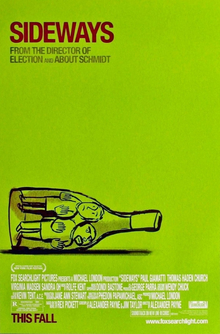
Sideways

I am always drawn to and am interested in depictions of the writing experience in film and other media. Sideways is one of the best. It is a 2004 Alexander Payne film adapted from the novel by Rex Pickett that stars Paul Giamatti and Thomas Hayden Church.


There are no actual scenes of writing in Sideways but, in a sense, that's the point. The experience of writing and trying to get one's work published is transformative many facets of one's life beyond the process of production itself. Sideways captures this with eery fidelity and a deft emotional tone. The character Myles has an unpublished manuscript that is the centrepiece of his life. He has not found fulfillment or success in marriage or career and now has nothing but this book. A book to which the publishing business appears cruelly indifferent. The film show in unsparing cruelty the inflation and then the destruction of Myles' hopes.

Beyond its resonance to the writer Sideways is simply a great film with complex and well drawn characters, a subtle comedic touch and moments of genuine pathos.

"In search of wine. In search of women. In search of themselves."